
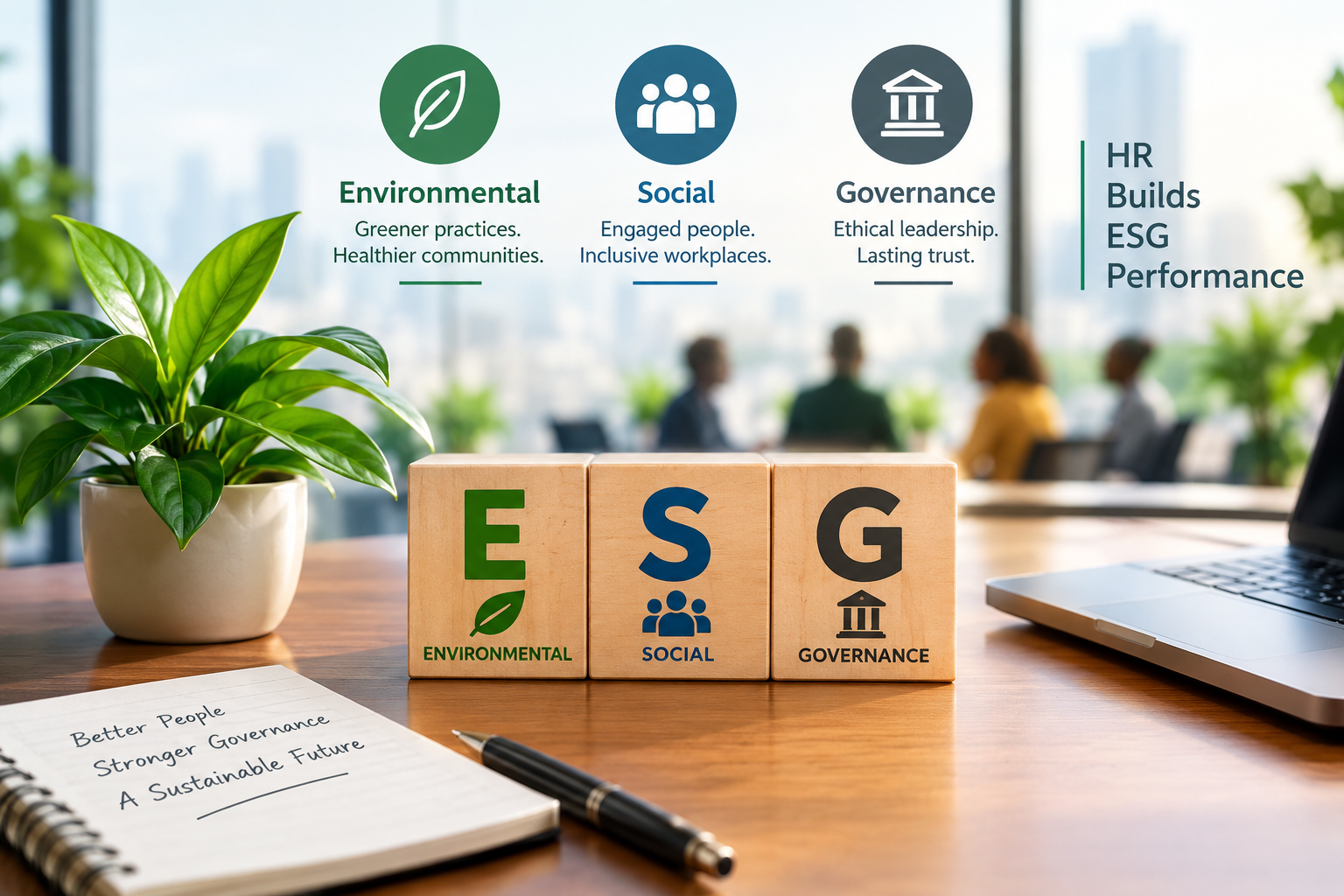
Environmental, Social and Governance (ESG) is no longer a topic reserved for sustainability teams and investor reports. Regulators, lenders, clients, and prospective employees now ask how organizations treat their people, manage risk, and make decisions. In most of these questions, HR holds the answer.
Of the three ESG pillars, the “S” and the “G” run directly through the HR function. The “E” is closer than it looks, too. Here is where HR makes the difference.
1. Social: Putting People at the Centre
The social pillar is about how an organization treats its employees and the communities it touches. HR owns most of these:
- Employee wellbeing: mental health support, reasonable workloads, flexible arrangements and safe workplaces are retention strategies.
- Diversity, equity and inclusion: fair recruitment, equal pay for work of equal value and real pathways for women, youth and persons with disabilities.
- Fair pay and compliance: accurate payroll, statutory remittances and clear contracts show that an organization keeps its promises to its people.
- Learning and development: investing in skills builds a workforce that can adapt, and it signals long-term commitment.
- Health and safety: preventing harm is the most basic social obligation an employer has.
2. Governance: Building Trust through Good Practice
Governance is about accountability, transparency, and ethical conduct. HR is often the custodian of the systems that make these visible:
- Policies that work: a code of conduct, anti-harassment, whistleblowing and conflict-of-interest policies only matter if they are communicated and enforced.
- Fair processes: consistent disciplinary, grievance and performance management procedures protect both employees and the organization.
- Data and privacy: employee records are sensitive, and compliance with data protection law is a governance issue.
- Ethical leadership: HR shapes how leaders are selected, assessed, and held accountable for behavior, not just results.
3. Environmental: The Quiet HR Contribution
HR may not run the sustainability programme, but it influences the culture that makes it succeed. Green awareness training, hybrid work that reduces commuting, paperless HR processes, and sustainability goals built into performance objectives all move the needle.
The honest framing: environmental initiatives are only real if employees adopt them. HR owns the engagement machinery that decides whether a green programme sticks or quietly dies. Commuting emissions and the share of staff in green travel schemes are the metrics that connect HR policy to environmental impact
4. Measuring What Matters
ESG credibility depends on evidence. HR can track and report indicators such as employee turnover, absenteeism, training hours per employee, gender and age representation, pay equity, workplace incident rates and employee engagement scores. What gets measured gets managed, and what gets reported builds trust with stakeholders.
5. Practical Steps for HR Leaders
- Start with a baseline: Audit current policies, workforce data and practices against ESG expectations. You will usually find around 60% already exists — it just isn’t documented to standard.
- Fix definitions before anything else: Turnover, absence, and training data typically live in three systems with three definitions. ESG reporting fails on definitions before it fails on substance.
- Align with business strategy: Link HR initiatives to the organization’s ESG goals and risks, with one named owner per metric and an explicit split of responsibilities between HR and sustainability.
- Build capacity: Train managers, because ESG outcomes are delivered in daily decisions, not in policy documents.
- Report consistently: Choose a few meaningful metrics and track them over time. Report internally for two cycles before anything goes external, and make every metric assurance-ready; the moment an auditor touches a manual spreadsheet, it becomes a finding.
- Listen to employees: Surveys and feedback channels show whether policies are lived or only written. Report the results back to staff
Conclusion
ESG performance is built on how an organization treats people and how it governs itself, and that is the daily work of HR. By linking wellbeing, fairness and accountability to measurable outcomes, HR professionals move from supporting the business to shaping its reputation and long-term value.
The organizations that treat ESG as a compliance chore will produce a report. The ones that let HR own the people side will produce a better company, and the report will be a by-product.
Ready to turn your people practices into measurable ESG results? Start with a baseline audit of your HR policies and data this quarter, and share how your organization is approaching it.